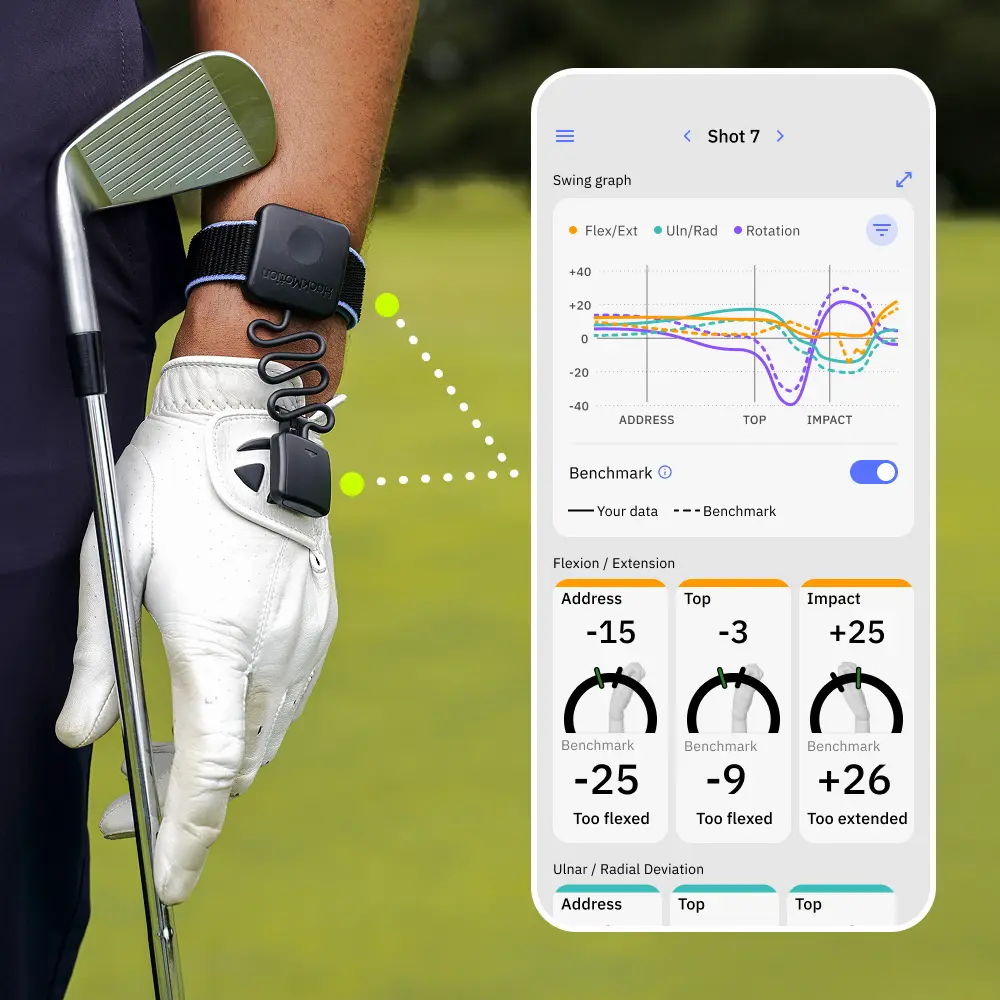
The HackMotion ($295) is a wrist sensor that shows your wrist angles in real-time. After 4 weeks, it exposed flaws I couldn't feel—like excessive extension at the top. Worth it for high handicappers who want data-driven feedback.
Related: GOLFTEC lessons
Let me start with a confession: I asked for a HackMotion. My wife bought it for my birthday because—and I quote—"Can't figure out what's wrong with my swing."
But here's the thing about the HackMotion: it doesn't just show you what's wrong with your swing. It shows you exactly what's wrong, in precise degrees, with real-time feedback, compared against what tour pros do. And then it expects you to fix it.
I've had this thing for four weeks now. I've learned more about my wrist mechanics than I ever wanted to know. And I'm pretty sure my swing has gotten less consistent because now I'm thinking about angles instead of just hitting the ball.
This is my honest review of the HackMotion—a training aid I simultaneously love and hate with equal intensity.
What the HackMotion Actually Is
For those who haven't seen one, the HackMotion is a small sensor that attaches to your lead wrist (left wrist for righties). It connects to an app on your phone and measures three things:
1. Flexion/Extension – Is your wrist bowed (flexed) or cupped (extended)?
2. Radial/Ulnar Deviation – Is your wrist hinged up or down?
3. Rotation – Is your forearm rotating open or closed?
It tracks these angles at setup, the top of your backswing, and impact. Then it compares your numbers to tour averages and tells you—with brutal honesty—how far off you are.
The sensor itself is well-built. Battery life is solid. The app is intuitive. Setup takes about 30 seconds. No complaints there.
The problem is what it reveals.
My first session with the HackMotion was humbling. And by humbling, I mean devastating.
I hit about 20 balls while the sensor recorded my wrist angles. Then I looked at the data.
At the top of my backswing, I had +18 degrees of extension. That's a cupped wrist. Tour average? About -14 degrees (that's flexion—a bowed wrist). I was 32 degrees in the wrong direction.
But here's the real gut punch: at impact, I had +12 degrees of extension. I was flipping. The sensor confirmed what my fat shots and slices had been telling me for years—I was adding loft at impact, keeping the face open, and not compressing the ball.
A flat wrist at impact is around 0 degrees. Slightly bowed (like the pros) is -5 to -10 degrees. I was at +12. I might as well have been scooping ice cream.
The HackMotion didn't just show me I was doing something wrong. It quantified exactly how wrong. And then it showed me a little graph comparing my swing to Dustin Johnson's.
Thanks. Very helpful. Dustin Johnson and I are basically the same except for the 60 degrees of wrist angle difference and the $75 million in career earnings.
The Drills Are Actually Good (When You Can Do Them)
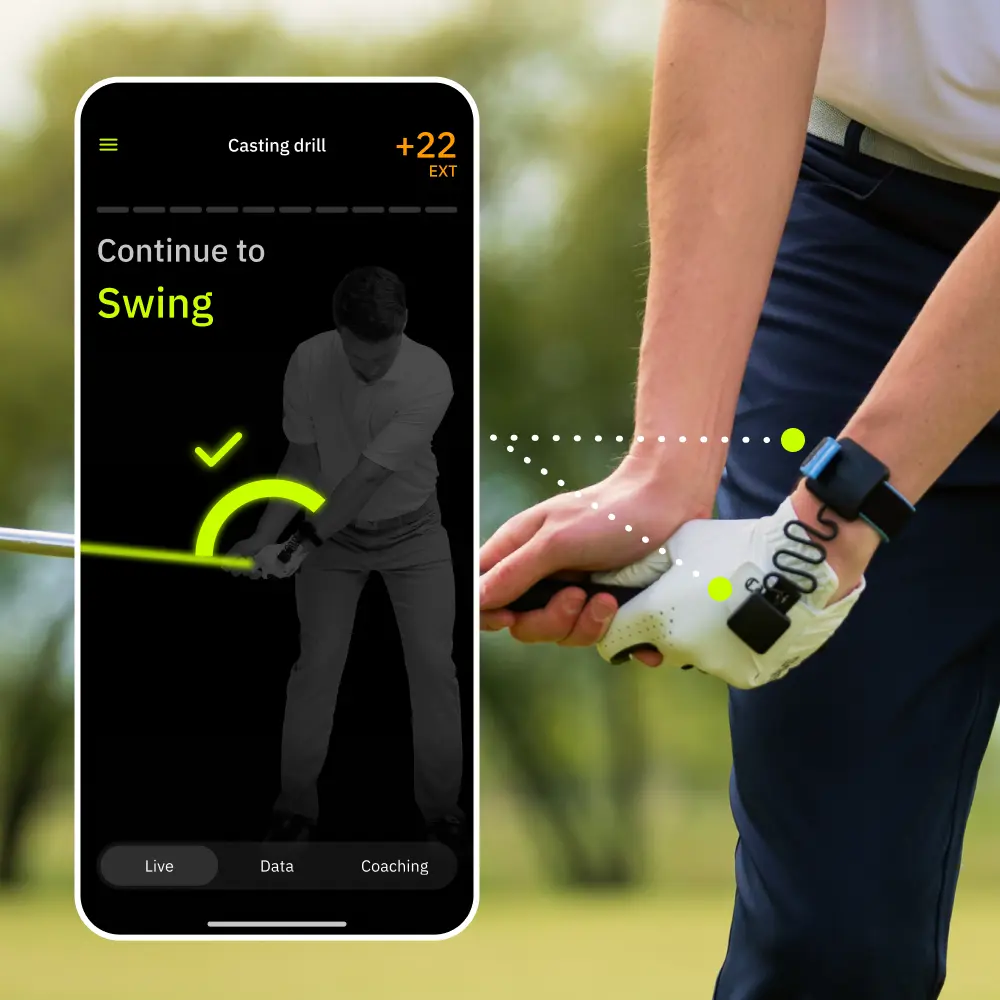
I'll give HackMotion credit—the app doesn't just diagnose problems. It provides structured drills to fix them.
The drill progression starts simple: make practice swings and try to hit a target wrist angle at the top of your backswing. The sensor gives you audio feedback—a beep when you're in the zone, silence when you're not.
Level 1 drills focus on the backswing. Level 2 adds the downswing. Level 3 works on impact position.
In theory, you work through these drills, build muscle memory, and gradually transform your flip into a proper release.
In practice? I can hit the target angles about 40% of the time in slow-motion practice swings. The moment I try to actually hit a ball, everything falls apart. My wrist cups. My body compensates. The sensor beeps disapprovingly.
It's like knowing you should keep your elbow in during a free throw but your arm does whatever it wants when the pressure's on.
What I Love About It
Despite my frustration, there are things the HackMotion does brilliantly:
1. It eliminates guesswork. Before HackMotion, I'd watch my swing on video and think, "My wrist looks kind of flat... maybe?" Now I know exactly what my wrist is doing. The data doesn't lie. When my GOLFTEC coach tells me to bow my wrist more, I can measure whether I'm actually doing it.
2. Real-time feedback accelerates learning. The audio cues help. When I make a practice swing and hear the "good" beep, my brain starts to associate that feeling with the correct position. It's biofeedback, and it works—slowly.
3. It connects the dots. I've wondered for years why my ball flight is so high and weak. HackMotion explained it in five minutes: I'm adding loft at impact because my wrist is cupped. Mystery solved. Now I just have to, you know, fix it.
4. Tour comparisons are motivating (and humiliating). Seeing how far my numbers are from tour average gives me a target. I'm not trying to be Dustin Johnson. But if I can get my impact extension from +12 to +5? That's progress.
What I Hate About It
And now, the frustrations:
1. Knowing isn't the same as doing. This is my core issue with the HackMotion. It shows me exactly what's wrong, but my body has 20 years of bad habits that don't disappear because a sensor beeped at me. I know I need to bow my wrist. I cannot make my wrist bow under pressure. The gap between knowledge and execution is maddening.
2. It can create paralysis by analysis. I've caught myself on the course thinking about wrist angles instead of just swinging. That's not good. Training aids belong on the range, not in your head during a round. But once you've seen the data, you can't unsee it.
3. The price is steep. I received mine as a gift, but the HackMotion Core runs $295. The Plus (which adds putting analysis) is $495. The Pro is $995. For a high handicapper who might not have the coordination to actually implement the fixes, that's a significant investment.
4. Progress is slow. After four weeks of drills, my average extension at impact has gone from +12 to +9. Three degrees. That's... something? But I was hoping for faster results. HackMotion isn't a quick fix—it's a long-term training tool that requires consistent practice.
Who Should Buy the HackMotion
Buy it if:
• You're serious about understanding your swing mechanics
• You have the patience for slow, incremental improvement
• You work with a coach who can help interpret the data
• You're a data nerd who wants to quantify everything (guilty)
• You've tried other fixes and nothing has worked
Skip it if:
• You want a quick fix (this isn't one)
• You tend to overthink on the course
• You're not willing to put in range time with structured drills
• You're on a tight budget—there are cheaper training aids that might help more immediately
The Verdict
The HackMotion is the most precise diagnostic tool I've ever used for my golf swing. It revealed exactly why I hit weak, high shots, and it's given me a clear path to fixing the problem.
The catch? I have to actually walk that path. And it's longer than I hoped.
After four weeks, I've gone from "completely flipping" to "slightly less flipping." That's not a testimonial they'll put on the box. But it's honest. And if I stick with it—another six months, another year—I believe the changes will compound.
My wife asked if the birthday gift was helping. I told her that I'll be making all the money back she paid for it by winning our clubs golf tournament this year.
She laughed and smirked at me.
Rating: 4 out of 5 stars
One star deducted because while it made me aware of my problems, it hasn't done enough to fix them yet.
– Jason
The HackMotion Core is available for $295 at hackmotion.com. They offer a 60-day money-back guarantee if you decide ignorance was bliss after all.